Thane West is treated as one place in conversation and behaves as five or six in practice. Pricing, character, commute and green cover vary enormously across a few kilometres, and a buyer who shortlists projects before shortlisting pockets ends up comparing things that are not comparable.
This guide describes the main pockets, what each is genuinely good and bad at, and who should be looking at which. It deliberately avoids quoting prices, because they move – but the relative positioning is stable and that is what actually decides your shortlist.
How to Judge a Micro-Market
Five criteria will separate the pockets of Thane West faster than any brochure.
Commute – not distance, but experienced journey time to where you actually go, at the hour you actually travel. Social infrastructure – whether schools, hospitals and daily retail are already in place or promised. Green cover and air – whether it is landscaping inside a compound or genuine open land nearby. Supply pipeline – how much competing stock is under construction, since that caps price growth and gives you alternatives. Character – family-led or nightlife-led, dense or spacious, established or emerging.
Run all five on any pocket you are considering and the shortlist usually cuts itself in half. Most buyers run only the first, and then wonder why the flat that looked ideal on paper does not feel right.
Score each pocket on all five before looking at a single project. Picking your Thane West pocket first is the highest-leverage hour in a property search.
Hiranandani Estate
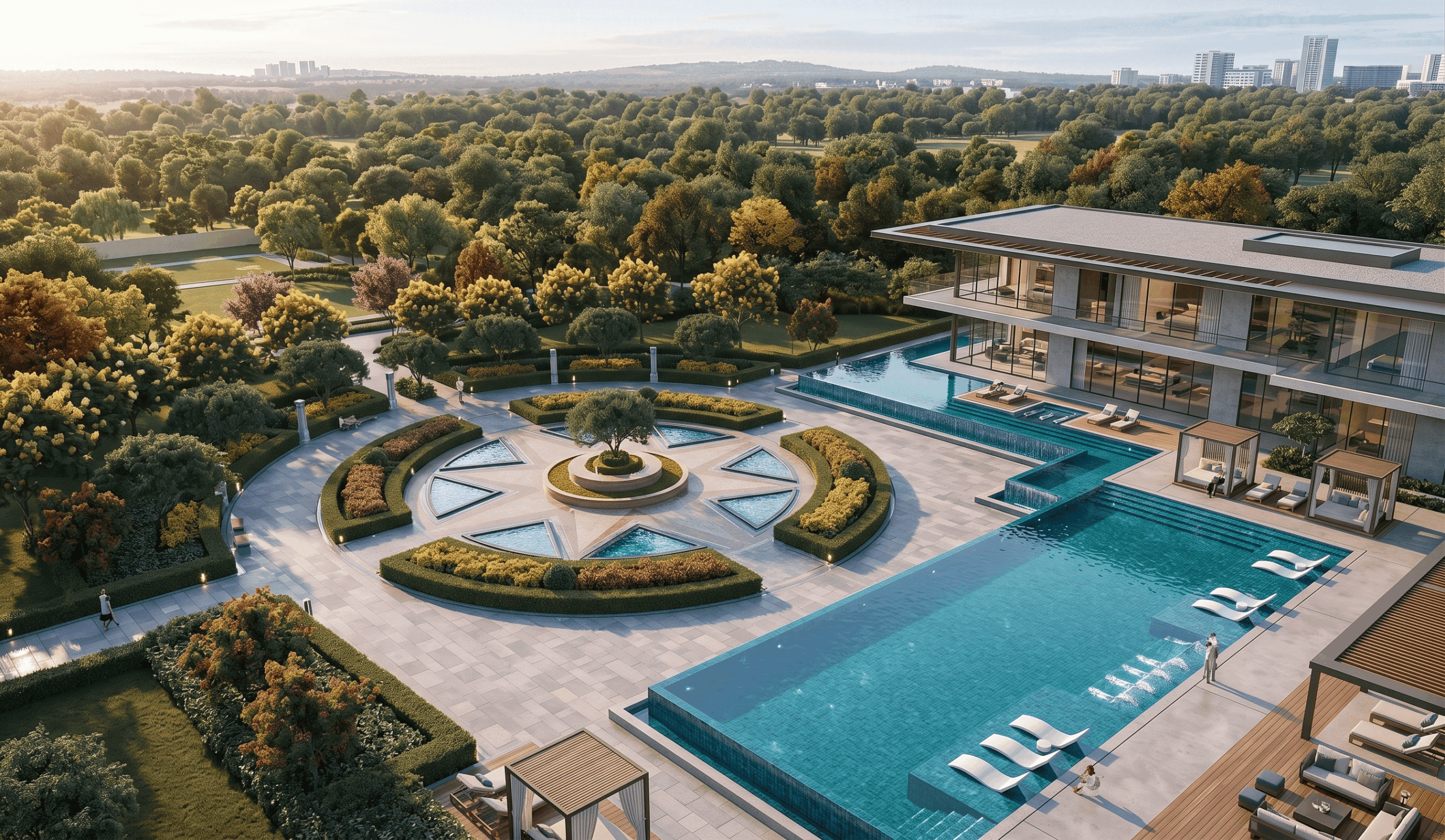
The premium end of Thane West and the most complete environment in it. Master-planned over decades, with its own schools, retail, healthcare and a coherent architectural language rather than a collection of unrelated towers.
What you get is predictability. The roads inside are laid out, the landscaping is mature, and the social infrastructure is not a promise. For families who value that, it is the benchmark the rest of Thane West is measured against.
What you pay is a premium, and it is a real one. You are also buying into an established environment where most of the value from the master-planning has already been recognised in price – so the case here is a good place to live rather than an obvious place to make money.
It suits buyers who want a finished environment and are willing to pay for it, and long-hold families who value stability over upside.
If your priority is a complete, finished environment on day one and budget is secondary, start here and use it as your quality benchmark for everything else.
Majiwada and Cadbury Junction
The most connected part of Thane West. Close to Thane station, close to the Eastern Express Highway, and at the junction where Ghodbunder Road meets the routes south.
For a household where someone commutes daily by train, or where the Eastern Express Highway is the main artery, this proximity is worth a great deal. Journey times are shorter and, crucially, more predictable than further up the corridor.
The cost is density and noise. This is the busiest part of Thane West, traffic at the junction is heavy, and green cover is limited to what individual projects provide inside their own compounds. It is urban rather than leafy.
It suits daily rail commuters, buyers who prioritise connectivity above all else, and investors targeting the tenant pool that wants to be near the station.
If someone in the household takes a train most days, the time saved here compounds over years. If nobody does, you are paying a premium for a benefit you will not use.
| Strongest for | Main trade-off | |
|---|---|---|
| Hiranandani Estate | A finished, master-planned environment | Premium pricing; most value already recognised |
| Majiwada / Cadbury Junction | Rail and highway commuters | Dense, busy, limited green cover |
| Manpada | Green outlook and family living | Longer, less predictable run to the station |
| Kolshet Road | Choice and negotiating leverage now | Heavy competing supply at resale |
| Kasarvadavali and north | Maximum carpet area per rupee | Longest commute; thinner social infrastructure |
Qualitative positioning for buyers new to Thane West. No prices are quoted because they move; relative positioning is more stable.
Manpada
Mid-corridor on Ghodbunder Road, with the Yeoor flank of the Sanjay Gandhi National Park immediately behind it.
That last point is the distinguishing feature of this pocket, and it is structural rather than cosmetic. Yeoor is protected forest, not landscaping with a marketing name. It cannot be developed away by the next launch, which means a hill-facing outlook here is more durable than a view over developable land anywhere else in Thane West.
The social infrastructure is established – schools across several boards, hospitals with emergency cover, two large malls within a short drive, and Tikuji-ni-Wadi nearby. The character is residential and family-led rather than nightlife-led.
The cost is the commute. Thane station is roughly six kilometres away and Ghodbunder Road congests at peak hours, so the run is longer and less predictable than from Majiwada. The proposed Thane-Borivali twin tunnel would change the westward calculation considerably if delivered, but it should be treated as upside rather than a reason to pay more today.
This pocket rewards households that will actually use the outdoors. If Yeoor would be scenery rather than somewhere you go, you are paying for something you will not use.
Kolshet Road
Branching off the main corridor, Kolshet has absorbed a large share of Thane West’s recent launch activity.
The upside of heavy supply is choice and competitive pricing. When several projects are selling simultaneously in one pocket, no single developer can price aggressively, and a patient buyer has genuine alternatives to walk to. That is a real advantage at the point of purchase.
The downside arrives later. Plentiful competing stock also means more competition when you come to sell or let, particularly if several projects reach possession around the same time. Resale in a pocket with heavy simultaneous completion is slower and more price-sensitive.
It suits buyers who want negotiating leverage now and intend to hold long enough for the supply to be absorbed – and it suits investors less well, for exactly the same reason.
Ask how many units in the Thane West pocket reach possession within two years of yours. That number is your competition at resale, and it is knowable in advance.
Myths worth clearing up
The best area in Thane West is whichever is most expensive.
Price reflects demand for a particular set of trade-offs. The best pocket is the one whose trade-offs match your commute, budget and horizon.
Green cover in a brochure means green surroundings.
Usually it means landscaping inside the compound. Genuine protected open land nearby – as at Manpada with Yeoor – is a different and more durable proposition.
More supply in a pocket is always good for buyers.
It helps when you buy and hurts when you sell. Ask how many units reach possession around the same time as yours.
Kasarvadavali and Further North
Continue north along the corridor and pricing eases as the distance from Thane station grows. This is the value end of Thane West.
For buyers priced out of the pockets closer in, the trade is explicit and honest: you pay less and you travel further. Newer supply here often means larger carpet areas for the same budget, which for a growing family can matter more than the extra fifteen minutes.
Social infrastructure is thinner than further south but is filling in steadily, and the corridor’s retail spine runs the whole length. The main risk is that infrastructure and amenity promises here lean more heavily on the future than on the present.
It suits budget-conscious end users who have honestly assessed the commute, and buyers who want maximum carpet area per rupee and are prepared to trade time for it.
Be brutally honest about the commute before choosing on price. A longer journey is easy to accept on a Sunday visit and hard to live with on a Wednesday evening.
Choosing Between Them
Work through it in this order. Establish where the household actually needs to be on a weekday – that eliminates entire pockets immediately. Set your all-in budget including stamp duty, registration, GST and one-time charges, which eliminates more. Then ask what you want the surroundings to be: finished and urban, or greener and quieter with a longer run in.
What remains is usually one or two pockets, and only then is it worth looking at individual projects. Comparing a project in Majiwada with one in Kasarvadavali is not a comparison; they are answers to different questions.
One final point. Whichever pocket you choose, verify the specific project on maharera.maharashtra.gov.in before committing. Market-level commentary on MMR supply and absorption is published periodically by consultancies including Knight Frank India, which helps sanity-check whether a pocket is running ahead of itself.
Decide the Thane West pocket, then the project, then the unit. Doing it in the other order is how buyers spend six months viewing flats that were never right.